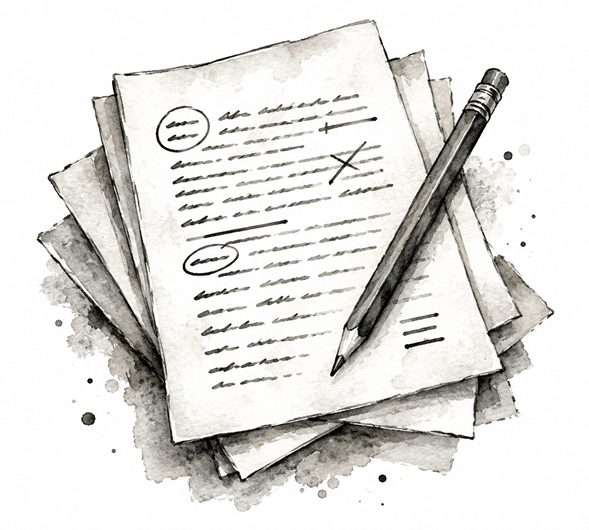
Editing
Editing is where you see what you have really written, not what you think you wrote.
Now Comes the Hard Part
You finally finished and are so proud of yourself.
The first draft is always disappointing. Now edit.
Does it need to be there?
Editing is not about cutting, it is about tightening up. All the words that are left should have a purpose.
Repetition
BeforeThe rain fell, falling as Sarah walked along the wet street.
AfterRain followed Sarah along the street.
Explaining twice
BeforeSarah hesitated because she was uncertain about whether she should go inside.
AfterSarah hesitated before she entered.
Too many words
BeforeThe rain fell very heavily and loudly against the windows.
AfterRain hammered against the windows.
Find the optimal way of saying it.
Don't tidy away the good bits
Don't cut anything just because it sounds weird. Use the weirdness.
A fragment
Rain. Again.Not a complete sentence. It doesn't need fixing if the break gives the moment the rhythm you want.
Repetition
She ran and ran and ran.Don't cut it if it fits. Here it can create rhythm, effort and the sense that the running keeps going.
Something unexpected
The rain smelled like copper.Rain does not smell like copper but blood does. Use description as a hint of things to come.
Know the rules. Then notice when the writer has broken one on purpose.
It can drizzle. It can hammer.
It can fall warm on a street beside the sea.
It can ruin Sarah's day or begin her story.
There isn't one way to write rain.
There is only the way your story needs it written.